
Article Contents ::
- 1 Abhrak bhasma Satva patan Satva Sodhan and Churnikaran Methods
- 2 Introduction Abhrak bhasma Satva patan Satva Sodhan
- 3 Three steps — Abhrak bhasma Satva patan Satva Sodhan
- 4 Satva patan :
- 5 Four steps Rasa Tarangani
- 6 Satva dravikaran
- 7 Satva pindikaran
- 8 Satva Sodhan &Churnikaran
- 9 Four steps Rasa Tarangani
- 10 Abhrak Satva Maran
- 11 Successive steps
- 12 Kupi pakva Vidhi
- 13 Puta pakva Vidhi
- 14 Ancient tests mentioned for Physico – chemical analysis of Bhasma
- 15 II.Method For Standardisation :
- 16 1.Organoleptic characters ofAbhrak bhasma:
- 17 Physical constants of Abhraka Satva Bhasma
- 18 Elements —
- 19 CONCLUSION
Abhrak bhasma Satva patan Satva Sodhan and Churnikaran Methods
s.o.p of satva bhasma w.s.r to abhrak satva bhasma Pure Abhrak Bhasma,Powdered Abhrak Bhasma
Introduction Abhrak bhasma Satva patan Satva Sodhan
- Pure Abhrak Bhasma,Powdered Abhrak Bhasma
- § As per the Rasa text Satva bhasma has been claimed to be more efficacious then other Iron Bhasmas for the treatment of diseases and to positive health.
- § Diabetes mellitus,TB or to improve immunity
- & to promotes physical & mental vigour etc.
- § Quality control is need of the hour.
- § To assure the quality & to establish the standards for Abhrak satva bhasma an attempt was made in this regards .
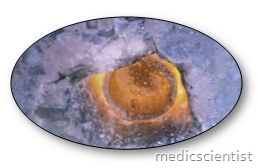
Three steps — Abhrak bhasma Satva patan Satva Sodhan
- 1
-
AbhrakSatvpatan - 2
-
Satva Sodhan&Churnikaran - 3
-
Abhrak SatvaMaran - Krishnabhraka
- Sanskrit- Abhrak
- English- Mica
|
- Krishnabhraka
- Sanskrit- Abhrak
- English- Mica
Satva patan :
- § Satvapatan means extraction of desired metal or alloy from a mineral for the prepration of bhasma.
Four steps Rasa Tarangani
- 1. Purification or refining of the mineral.
- 2. Mixing with the reductant and flux etc.
- 3. Agglomeration.
- 4. Smelting.

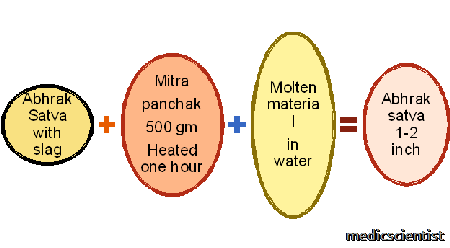
Satva dravikaran
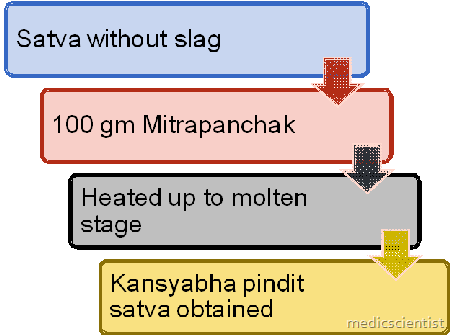
Satva pindikaran
| Material | Sample (1) | Sample (2) | Sample (3) |
| Biotite | 5 kg | 5 kg | 5 kg |
| Borax | 1 kg 250 gm | 1 kg 250 gm | 1 kg 250 gm |
| Sweta Musli | 2 kg | 2 kg | 2 kg |
| Water for Kwatha | 20 lit | 20 lit | 20 lit |
| Wt of the balls | 8 kg | 7 kg | 8.2 kg |
| Total time in Satv patan | 6 hour | 6 hour | 7 hour |
| Wt of Mitrapanchak for pindikaran | 100 gm | 100 gm | 100 gm |
| Wt of satva obtained | 495 gm | 490 gm | 500 gm |
Satva Sodhan &Churnikaran
Four steps Rasa Tarangani
- Pure Abhrak Bhasma,Powdered Abhrak Bhasma
-
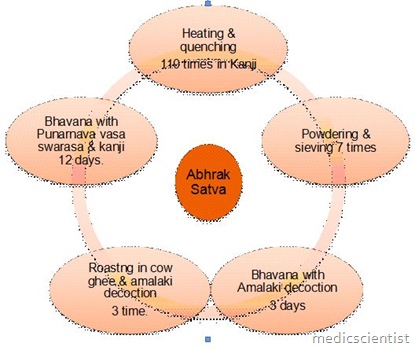
- 1. Heating & quenching (Nirvapan).
- 2. Powdering.
- 3. Roasting & Trituration.
- 4. Bhavna & Mardan.
Abhrak Satva Maran
| Material | Sample (1) | Sample (2) | Sample (3) |
| Abhrak Satva | 400 gm | 400 gm | 400 gm |
| Kanji for one nirvap | 2 lit | 2 lit | 2 lit |
| Wt of powdered satva | 410 gm | 412 gm | 415 gm |
| Amalki kwath for Bhavana & 3 Roasting | 3 lit | 3 lit | 3 lit |
| Cow ghee for 3 time roasting | 450 gm | 450 gm | 450 gm |
| Punarnava Swarasa for Bhavana | 500 ml | 500 ml | 500 ml |
| Vasa swarasa for Bhavana | 300 ml | 300 ml | 300 ml |
| Kanji for Bhavana | 300 ml | 300 ml | 300 ml |
| Wt of final product | 420 gm | 415 gm | 422 gm |
Successive steps
Kupi pakva Vidhi
- (Process repeated two time in each sample)
| Material | Sample (1) | Sample (2) | Sample (3) |
| Abhrak Satva churna | 240 gm | 240 gm | 240 gm |
| Sudh Parad | 60 gm | 60 gm | 60 gm |
| Sudh Gandhak | 60 gm | 60 gm | 60 gm |
| Time taken in kajjli formation | 24 hour | 24 hour | 24 hour |
| Wt of kajjli | 490 gm | 490 gm | 490 gm |
| Time in kupipaka | 12 hour | 12 hour | 12 hour |
| Wt of Satva Sindur | 110mg | 100mg | 104mg |
| Wt of Satva bhasma | 265 gm | 270 gm | 263 gm |
| Wt of bhasma after 2nd k.paka | 316 gm | 310gm | 315gm |
Puta pakva Vidhi
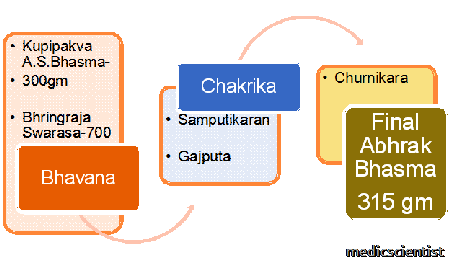
Ancient tests mentioned for Physico – chemical analysis of Bhasma
- 1. Nischandratwa(Without shining or luster)
- 2. Rekhapurna(enter into furrows of figure)
- 3. Anjansadrisha( fine like collyrium)
- 4. Laghuta ( lightness)
- 5. Varitar ( Floates over water & unam )
- 6. Mruduta ( softness)
- 7. Slakhnatva. ( Smoothness )
- 8. Nirdhoomatwa ( smokeless)
¢ B)
- 1. Niruthatwa (not regaining it’s original form.)
- 2. Apunarbhavatwa (not regaining it’s original
- form.)
- 3. Gatarasatwa (tastelessness / swadarahita)
- 4. Avami (No vomiting sensation)
- 5. Amlatva pariksha (test with sour – juice )
II.Method For Standardisation :
- • Organoleptic characters
- • Qualitative & Quantitative analysis by
- Inductively coupled Plasma Atomic
- Emmission Spectroscopy.
- • PH value , Moisture content, Ash
- value were noted.
1.Organoleptic characters ofAbhrak bhasma:
| Characters | Suddh Abhrak | S.Abhrak Satva | Abhrak Satva Bhasma |
| Color | Krishna | Dhuser | Brick Red |
| Odour | Dhanya gandhi | Odourless | Odourless |
| Taste | Tasteless | Tasteless | Tasteless |
| Touch | Smooth | Smooth | Smooth |
| Appearance | Powder | Powder | AmorphusPowder |
Physical constants of Abhraka Satva Bhasma
| Characters | Suddh Abhrak | S.Abhrak Satva | Abhrak Satva Bhasma |
| Moistre content | 0.43 % | 0.037 % | 1.27 % |
| Acid insoluble content | 48.52 % | 1.32 % | 6.87 % |
| Water soluble | 0.46% | 0.43% | 11.46% |
| Ash value | 96.61% | 122.14 % | 90.56% |
| PH value | 10.77 | 7.73 | 3.83 |
Elements —
| Elements | S. Abhrak | S.Abhrak Satva | A.S. Bhasma |
| Fe2O3 | 14.14 | 85.9 | 56 |
| MgO | 7.44 | 0.0586 | 0.0648 |
| Al 2 O3 | 17.16 | 0.290 | 0.405 |
| K2O | 5.75 | 0.057 | 0.210 |
| Zn | 0.02 | 0.0073 | 0.0273 |
| Cd | – | 0.0010 | 0.0008 |
| Pb | – | 0.0068 | 0.0068 |
CONCLUSION
- ¢ Iron ,Magnessium , Aluminium , Silicon ,
- Calcium, Potassium within permissible amount
- and Zinc,Tin,Barium,Phosphorous,Manganese
- in trace amount were detected in Abhrak Satva Bhasma.
- ¢ Significant increase in percentage of Iron
- as compared to % of Iron in Raw.
- • Percentage of Abhrak Satva obtained was — 10 %.
- • After sodhan increased wt of Abhrak Satva was – 2.5 %.
- • After Kupipaka method increase in wt of Satva Bhasma was – 31.66 %.
- • Wt of Satva Sindur obtained by Putpaka method was – 220 mg.
- • After putpaka method no increase in wt of Satva Bhasma was observed.