
Article Contents ::
- 1 Interstitial Lung Diseases
- 2 Clinical Features of Interstitial Lung Diseases
- 3 Interstitial Lung Diseases Physical examination
- 4 Lab diagnosis
- 5 X-RAY
- 6 CT – HRCT
- 7 Pulmonary function test
- 8 Diffusing capacity
- 9 Arterial blood gases
- 10 Fiberoptic bronchoscopy and bronchoalveolar lavage
- 11 Treatment of Interstitial Lung Diseases
Interstitial Lung Diseases
- A large group of diseases with different causes but with the same or similar clinical and pathological changes.
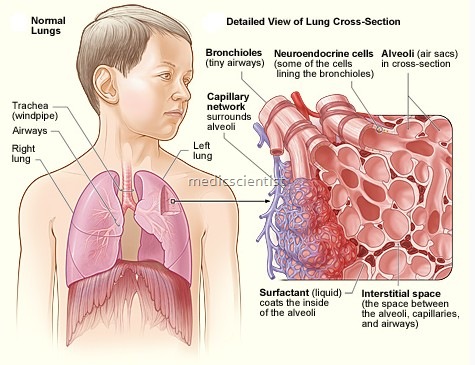
- The interstitial lung diseases (ILD) are diseases of lung parenchyma/ alveoli/ alveolar epithelium/ capillary endothelium/ and the spaces between These structures/ perivascular and Imphatic tissues.
- These are due to chronic, nonmalignant, noninfectious diseases of the lower respiratory tract characterized by inflammation and disruption of the walls of the alveoli.
- Diffuse parenchymal lung diseases, often collectively referred to as the interstitial lung diseases (ILDs), are a heterogeneous group of disorders that are classified together because of similar clinical, roentgenographic, physiologic, or pathologic manifestations (show table ) .
- This manifests clinically as a limitation in the ability of the lungs to transfer oxygen from the alveoli to the pulmonary capillary bed.
- However, the term interstitial is misleading, since most of these disorders are also associated with extensive alteration of alveolar and airway architecture.
- Patients with these disorders are dyspneic first in connection with exercise and, later, as the disease progresses, even at rest.
- There is diffuse parenchymal lung involvement, connective tissue involvement, and either fibrosis or granuloma formation. The cause may be known or unknown.
- The disease may have 2 phases – Acute & Chronic phase. The disease is usually recurrent.
- Interstitiai C1iseases of unknown etiology Sarcoidosis,’Idiopathic pulmonary fibrosis, Wegener’s granulomatosis, SLE, rheumatoid arthritis, tioodpasture’s syndrome.
- Interstitial diseases of known etiology Asbestos, drugs like amiodarone, antibiotic, gold, hypersensitivit neumonitis.
Clinical Features of Interstitial Lung Diseases
- Presentation may be acute, sub-acute or chronic. Age commonly affected is 20 – 40 years.
- There may be a family history of interstitial lung disease.
- Some diseases are more common in women but pneumoconfosis is mOre common in men.
- ILD is very common in smokers.
- Symptoms are dyspnoea, wheezing, substernal discomfort, chest pain, hemoptysis, fatigue, weight loss .
Interstitial Lung Diseases Physical examination
- Tachypnoea, bilateral basal inspiratory crackles, Wheeze, cyanosis, and clubbing.
Lab diagnosis
- ANA (Antinuclear antibodes), anti immuno globulin antibodies, circulating immune complexes, anti-basement anti~6dies=-serum _Rr~ciRitins in hypersensitivity pneumonitis.
X-RAY
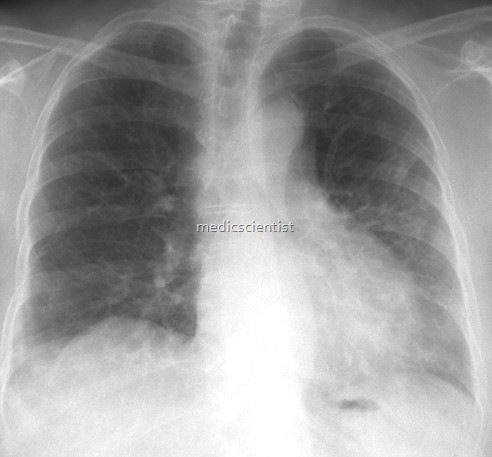
- Bilateral basal reticular pattern.
- Nodular opacities especially in upper zones. -)Honey-combing.
- Progressive changes of fibrosis.
CT – HRCT
- CT and High resolution CT for early detection and confirmation.
Pulmonary function test
- Spirometry and lung volumes show a restrictive defect with reduced total lung capacity, reduced FEV1 and FVC, increased FEV1 j FVC.
Diffusing capacity
- There is reduction in diffusing capacity for carbon monoxide in ILDs.
Arterial blood gases
- May be normal, or show hypoxaemia, respiratory alkalosis, hypocapnia, normocapnia, and rarely hypercapnia.
Fiberoptic bronchoscopy and bronchoalveolar lavage
- Is useful for diagnosis of sarcoidosis, hypersensitivity pneumonitis.
Treatment of Interstitial Lung Diseases
- Removal of stimulus
- Suppression of inflammation
- Supplemental oxygen
- Glucocorticoids-Prednisone 1 mg/kg once daily’ orally for 4-12 wks.
- Cyclophosphamide and Azathioprine 0,/ Lung transplantation.