
Article Contents ::
- 1 Mechanical Ventilatory Support
- 2 Indications
- 3 Hypoxaemic respiratory failure :
- 4 Hypercarbic respiratory failure :
- 5 How it works?
- 6 Ventilator Modes
- 7 Modes of ventilation
- 8 Synchronized intermittent mandatory ventilation (SIMV)
- 9 Continuous positive
- 10 Pressure control ventilation (PCV)
- 11 Pressure support ventilation (PSV)
- 12 Non-invasive ventilation (NIV)
Mechanical Ventilatory Support
- Ventilators are special pumps to support ventilatory function of the respiratory system and improve oxygenation by providing high oxygen and positive pressure.
Indications
-
Hypoxaemic respiratory failure :
- arterial oxygen saturation (Sa02) less than 90% inspite of inspired oxygen fraction FI02 > 0.6.
- Causes
- Pneumonia
- Pulmonary edema
- ARDS,
Hypercarbic respiratory failure :
- arterial PC02 >50 mmHg qnd arterial pH <7.30
- Causes
- Neuromuscular diseases like myasthenia
- gravis, myopathies
- Asthma
- COPD
- Restrictive lung diseases
- In acute hypercarbic respiratory failure mechanical ventilation must be instituted in all cases.
- In chronic hypercarbic respiratory failure
- mechanical ventilator su port mayor may not be given.
- Mechanical ventilation is also given in cases of raised intracranial pressure, congestive heart failure, myocardial infarction, unconscious patients, post-operative conditions.
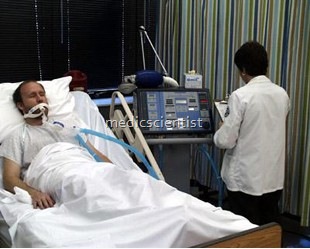
How it works?
- Mechanical ventilators provide humidified gas through an airway opening of a specific volume, pressure, and time-pattern.
- Ventilators serve as energy source to replace the effort of the respiratory muscles.
- Usually inspiration is taken over by the ventilator by providing a positive pressure but expiration is passive and occurs without any effort.
- A positive end-expiratory pressure (PEEP) is delivered which helps to maintain the patency of alveoli and airways and reverses hypoxaemia and atelectasis.
- PEEP levels are between 0-10 cm water.
- A cuffed endotracheal tube is inserted to deliver oxygen gas to the lungs .
- Neuromuscular paralysis may be required and it is usually achieved by succinyl choline, morphine, fentanyl, ketamine or recently by propofo!.
- If ventilator therapy is required for more than 3 weeks. tracheostomy is done to reduce laryngeal injury.
Ventilator Modes
- Mode means the manner in which ventilator breaths are triggered, cycled, and limited.
- Trigger is the inspiratory effort or a timed signal.
- Cycle is the point where inspiration ends by volume,
- pressure or time or flow.
- Limiting factors are airway pressure or inspiratory flow.
Modes of ventilation
- Assist control mode ventilation (ACMV)
- An inspiratory cycle is triggered by patient’s inspiratory effort or a timed signal. It is used for initiation of mechanical ventilation.
- It is also used for weaning patients from mechanical ventilation.
Synchronized intermittent mandatory ventilation (SIMV)
- The patient is allowed to breathe spontaneously without ventilator assistance, with ventilator breaths in between. Mandatory breaths are in synchrony with patients efforts at a fixed frequency.
- If the patient fails to breathe spontaneously the ventilator delivers breaths till the patient breathes spontaneously.
- SIMV allows patients with spontaneous respiration to breathe, supporting the breaths, and helps to wean intubated patients.
Continuous positive
- airway pressure (CPAP) The ventilator provides fresh gas, gives each inspiration and provides pressure from 0-20 cm water.
- It is useful for patients with intact respiratory function with endotracheal tube for airway protection.
Pressure control ventilation (PCV)
- During inspiration, a given pressure is use to drive the gas in. It is used in patients with severe hypoxaemic respiratory failure.
Pressure support ventilation (PSV)
- This form is patient-triggered, flow-cycled, so that patient receives ventilator assistance only when there is an inspiratory effort by the patient.
Non-invasive ventilation (NIV)
- This is given without endotracheal intubation through a tight-fitting face mask.
- Commonly used in sleep apnea patients, and as a primary ventilator support in patients with impending respiratory failure.
- It is also called bipap or bi-Ievel positive airway pressure ventilation.
- It is well tolerated by the conscious patient and the most commonly used method of ventilation in reus today.