
Ashoka Saraca asoca
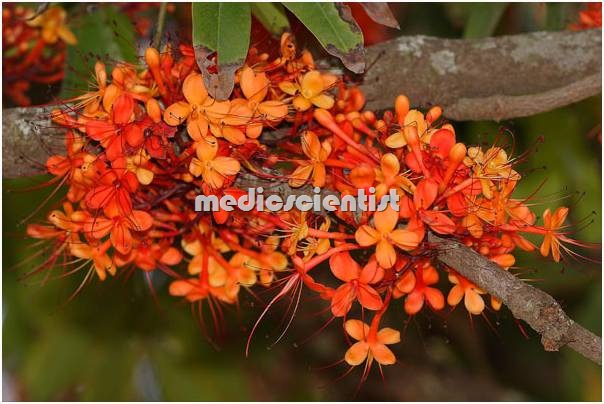
The Ashoka is prized for its beautiful foliage and fragrant flowers. Ashoka Saraca asoca Ayurvedic Medicinal value for GIT, and Blood purification .They are bright orange-yellow in color, turning red before wilting. Its flowering season is around February to April.
- Ashoka consists of dried stem bark of Saraca asoca (Rose.) Willd , Syn. Saraca indica Linn. (Fam. Leguminosae), collected in spring from mature, wild or cultivated trees, found in Central and Eastern Himalayas, Western Ghats and Deccan.
Scientific classification
- Kingdom: Plantae
- (unranked): Angiosperms
- (unranked): Eudicots
- (unranked): Rosids
- Order: Fabales
- Family: Fabaceae
- Genus: Saraca
- Species: S. asoca
- Binomial name — Saraca asoca
SYNONYMS
- Sanskrit : Kankeli
- Hindi : Ashoka
- English : Asok Tree
- Assamese : Ashoka
- Bengali : Ashoka
- Gujrati : Ashoka
- Oriya : Ashoka
- Punjabi : Asok
- Tamil : Asogam, Asogu, Asokam
- Telugu : Ashokapatta
- Kannada : Ashokadamara, Ashokamara, Kankalimara
- Kashmiri : Ashok
- Malayalam : Asokam
- Marathi : Ashok
DESCRIPTION
- The Ashoka is a rain-forest tree. Its original distribution was in the central areas of the Deccan plateau, as well as the middle section of the Western Ghats in the western coastal zone of the Indian Subcontinent.
- The Ashoka is prized for its beautiful foliage and fragrant flowers.
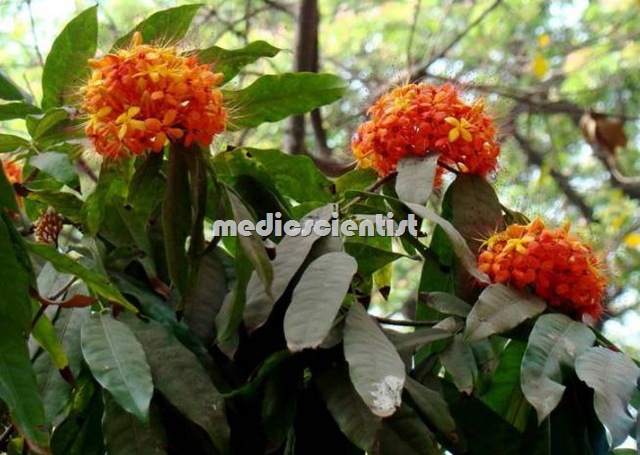
- They are bright orange-yellow in color, turning red before wilting.
- Its flowering season is around February to April.
- It is a very handsome, small, erect evergreen tree, with deep green leaves growing in dense clusters.
- The Ashoka flowers come in heavy, lush bunches.
- As a wild tree, the Ashoka is a vulnerable species.
- in scattered locations of the northern plains of India as well as on the west coast of the Subcontinent near Mumbai.
- It is becoming rarer in its natural habitat, but isolated wild Ashoka trees are still to be found in the foothills of central and eastern Himalayas,
Macroscopic and Microscopic examination —
- Bark channelled, internally reddish-brown with fine longitudinal strands and fibers, fracture splintery exposing striated surface,
- externally dark green to greenish grey, smooth with circular lenticels and transversely ridged, sometimes cracked, a thin whitish continuous layer is seen beneath the cork layer, taste, astringent.
- Transverse section of stem barksecondary cortex wide with one or two continuous layers of stone cells with many patches of sclereids, shows periderm consisting of a wide layer of cork, radially flattened, narrow cork cambium, parenchymatous tissue contains yellow masses and prismatic crystals:
- secondary phloem consists of phloem parenchyma, sieve tubes with companion cells and phloem fibres occuring in groups, crystal fibres present.

CONSTITUENTS –
- Tannins and a crystalline glycoside.
PROPERTIES AND ACTION Guna —
- Rasa : Kashya, Tikta
- Guna : Laghu, Ruksha
- Virya : sheeta
- Vipaka : Katu
Karma :
- Grahi,
- Hradya,
- Vishhagna,
- Sothahara
IMPORTANT FORMULATIONS –
- Ashokarist , and Ashokaghrita
THERAPEUTIC USES –
- Asrgdara,
- Apachi,
- Daha,
- Raktsodhan (blood purifier),
- sotha
DOSE ayurveda Drugs –
- 20-30 g of the drug for decoction.