
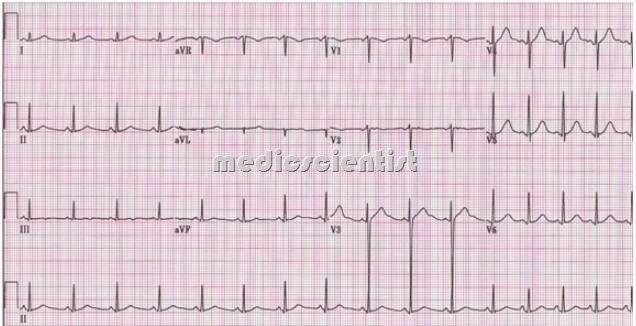
BRADYARRHYTHMIAS Sinus BRADYCARDIA
When the sinus rate is less tha – 60 beats per minute it is called sinus bradycardia,Trained athletes and people doing hard labour, elderly individuals may have resting rate less than 50 beats per mmute.
- The pacemaker of the heart is the sinoatrial node (SA node).
- The SA node lies at the junction of right atrium and superior vena cava.
- The SA node is supplied by the sinus node artery which is a branch of right coronary artery.
- The impulse which arises from the SA node travels across the atrium to the AV node (atrioventricular node). The blood supply of the AV node is from the posterior descending coronary artery. The AV node lies at the base of the interatrial septum.
- The AV node has the property of slowing the conduction hence the PR interval seen in ECG. From the AV node the impulse travel to the His bundle which is a continuation of the AV node.
- From the bundle of His the impulse travels across the membranous interventricular septum and divides into the left bundle branch and the right bundle branch.
- These right and left bundle branches divide into fine network of fibers throughout the endocardium of the ventricles. This network is called the His Purkinje system.
- Stimulation of vagus depresses the automaticity of SA node, depresses the conduction and increases the refractOriness an pro ongs the conduction time of the tissues of atria and ventricles and AVnod~
- The SA node is the dominant pacemaker of the heart.
- During exercise the heart rate increases and during sleep the heart rate decreases under autonomic influence. The normal heart rate is 60 to 100 beats per minute.
Sinus BRADYCARDIA —

- Sinus arrhythmia often accompanies sinus bradycardia, but the P waves have a normal morphology unless atrial disease is present.
- A PR interval of up to 0.21 is normal in sinus bradycardia.
- When the sinus rate is less tha~60 beats per minute it is called sinus bradycardia.
- (Sinus tachycardia: When the sinus rate is more than100 beats per minute it is called sinus tachycardia
- Trained athletes and people doing hard labour, elderly individuals may have resting rate less than 50 beats per mmute.
CLINICAL MANIFESTATIONS —
- Sinus bradycardia is usually asymptomatic.
- However, symptoms related to the slow heart rate can occur, including presyncope lightheadedness,or syncope, and worsening of angina pectoris or heart failure.
- which is frequently ascribed to aging rather than bradycardia.
- Symptoms may be subtle, with many patients noting only fatigue,
Causes of Sinus node disease
- 1. Ischemia of sinus node
- 2. Degenerative diseases
- 3. Senile amyloidosis
- 4. Hypothyroidism
- 5. Advanced liver disease
- 6. Hypothermia
- 7. Typhoid fever
- 8. Brucelosis
- 9. Hypoxia, hypercapnia, acedemia
- 10. Acute hypertension
- 11. Vasovagal syncope
- 12. Drugs like digitalis, beta blockers, calcium channel blockers, amiodarone etc.
Sinus BRADYCARDIA TREATMENT —
- Treatment is not indicated in asymptomatic patients with sinus bradycardia.
- Search for a medication that may be depressing sinus node function.
- The following approach should be followed when symptoms occur.
- Sympatholytic agents should not be discontinued abruptly, because a withdrawal syndrome may be seen characterized by severe hypertension and, with abrupt beta blocker withdrawal, the precipitation of angina.
- As an example, a beta blocker,calcium channel blocker,nondihydropyridine or sympathetic blocker can be replaced in hypertensive patients with drugs that do not affect SA node function, such as an ACE inhibitor.
- when the SA node is depressed by excessive parasympathomimetic activity or possibly ischemia.
- the SA node rate generally increases after the administration of a vagolytic drug, such as atropine .
- Pharmacologic therapy may be important in an acute myocardial infarction ,
- Long-term pharmacologic therapy is largely ineffective in chronic sinus bradycardia.
- Temporary pacing is rarely necessary.