
Article Contents ::
Fever — Common Causes And Treatment
Clinicians commonly refer to a febrile illness without an initially obvious etiology (sometimes called fever without localizing signs)
- Fever is an elevation in the core body temperature above the individuals normal range that occurs in conjunction with an increase in the hypothalamia temperature set point.
- Fever is defined as a core body temperature of 38°C –100.4°F.
- Hyperpyrexia, a medical emergency, is defined as a temperature over 41.1°C –€€106.0°F
- Hyperthermia is an elevated body temperature without a change in the hypothalamus setting.
 |
| TERMAMETER |
- Fever is an elevation in the core body temperature above the individuals normal range that occurs in conjunction with an increase in the hypothalami temperature set point.
- Fever is defined as a core body temperature of 38°C ==100.4°F
- Hyperpyrexia, a medical emergency, is defined as a temperature over 41.1°C (106.0°F).
- . Hyperthermia is an elevated body temperature without a change in the hypothalamic setting.
II. Pathophysiology of Fever
- A. Mechanisms of temperature control
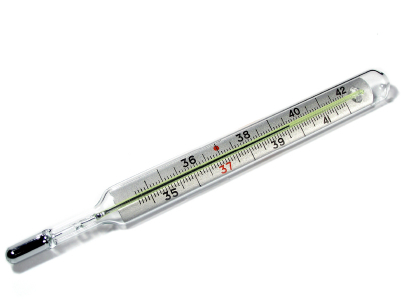 |
| HUMAN THERMOMETER |
- Body temperature is controlled by the hypothalamus, which receives inputs from both the peripheral nerves and from the temperature of the blood supplying the area.
- Normal body temperature is maintained across environmental this is called homeostatic control variations through the regulation of heat production from metabolic activity €€mostly of the muscles and liver€ and heat dissipation from the skin and lungs.
- It is widely held that normal body temperature is 37.0°C €98.6°F€, but several studies have shown that average temperatures in healthy adults range from 30.0°C to 37.2€°C (86.0°F–99.0°F) with averages 36.4°C to 36.8°C €97.5°F–98.2°F€€ and 99th percentile 37.5°C to 37.7°C €€99.5°F–99.9°F)(1,2).
Temperature measurement in Fever
- How the temperature is taken can affect the result.
- Patients with temperatures between 38.9 and 41.0ºC can be assumed to have an infectious cause for their fever.
- Rectal temperature is considered the closest approximation to core temperature.
- Conventional means of measuring temperature in ICU patients include intravascular, intravesical, rectal, oral, cutaneous, and tympanic. Each has advantages and disadvantages
- €€Sublingual temperatures are felt much reliable, and generally measure 0.6€°C (1.0°F) lower than rectal temperatures.
- Whichever method is employed should be used consistently and the site of measurement documented.
- Axillary and tympanic measurements are less reliable, with axillary temperatures ranging from 0.25°C to 0.85°C (€€0.4°F1.5°F) lower than rectal measurements, and tympanic measurements ranging from 1.3°C (2.3°F) lower than rectal to 0.7°C (€1.3°F) higher (3,4).
Temperature variation —
- Normal body temperature varies by an average of 0.5°C (0.9€°F) throughout the day, with the lowest temperature early in the morning and peak in the mid afternoon.
- Other factors that influence normal body temperature include age, race, physical activity, postprandial state, pregnancy or ovulation, endocrine disorders, clothing, and ambient temperature and humidity. EvaluationA. History —
- A detailed history is essential to establishing the cause of fever.
The history should include the following components:
- • €€=Complete review of systems as well as past medical problems
- • €€=Previous surgeries, with attention to any implanted materials or devices
- • €€=Medications, supplements, and other drugs used
- • €€=Recent and remote travel
- • €€=Exposure to ill individuals
- • Exposure to animals or insects
- • €€=Occupation
- • €€=Ingestion of any questionable foods or substances
- • €€=Family history of unusual illnesses
Physical examination Fever —
- Careful physical examination should be performed.
- • Temperature and other vital signs should be measured very accurately.
- Heart rate, blood pressure, and respiratory rate normally increase in the face of fever. €€Bradycardia may be a sign of atypical infections.
- Hypotension may be a sign of systemic sepsis.
- • €€An examination of all organ systems and body areas should be performed, €€with emphasis given to the skin, lymphatics, heart, lungs, and nervous system.
- In addition, genital and rectal examinations should be performed regardless of gender.