
Article Contents ::
- 1 Tubular Diseases of the Kidney
- 2 POLYCYSTIC KIDNEY DISEASE
- 3 Autosomal dominant polycystic kidney disease
- 4 Clinical Features of POLYCYSTIC KIDNEY DISEASE
- 5 Autosomal recessive polycystic kidney disease
- 6 VON HIPPEL–LINDAU DISEASE
- 7 MEDULLARY SPONGE KIDNEY
- 8 MEDULLARY CYSTIC NEPHRONOPHTHISIS
- 9 LIDDLE’S SYNDROME
- 10 BARTTER’S SYNDROME
- 11 GITELMAN’S SYNDROME
- 12 RENAL TUBULAR ACIDOSIS
- 13 There are four types of RTA
- 14 Type 1 RTA -This is also called distal RTA.
- 15 Type 2 or Proximal RTA
- 16 Type 4 RTA It is also called hyperkalemic distal RTA.
Tubular Diseases of the Kidney
- The tubular diseases of the kidney have various presentations.
POLYCYSTIC KIDNEY DISEASE
Autosomal dominant polycystic kidney disease
- This is a relatively common cause of end-stage renal disease (ESRD).
- The kidneys are enlarged with multiple cysts.
- The cysts contain straw-colored or hemorrhagic fluid. The cysts are spherical and may be even a few ems in size.
- There is also i’nterst’itial fibrosis and nephrosclerosis.
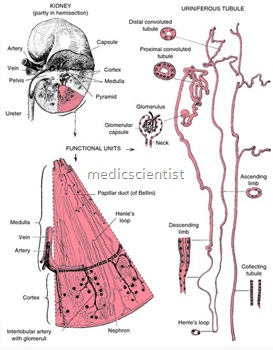
Clinical Features of POLYCYSTIC KIDNEY DISEASE
- · May present ~t any age.
- · Symptoms begin in 3rd or 4th decade.
- · There is chronic pain in the flanks.
- · Acute pain may be due to UTI, and urinary tract
- obstruction by clot, stone or haemorrhage.
- · Nocturia may be present.
- · Nephrolithiasis (renal stones) is common.
- · There is hypertension especially in adults.
- · ESRD sets in rapidly after 3rd decade.
- · There is renal failure due to hypertension, infections, ureteral obstruction.
- · There may be cysts in the spleen, pancreas and ovaries.
- · There may be intracranial aneurysms and subarachnoid haemorrhage.
- · There may be MVP (mitral valve prolapseL AR, TR.
- · Urine pH is low.
Diagnosis
- Ultrasound – is the best technique for polycystic disease.
- CT scan
POLYCYSTIC KIDNEY DISEASE Treatment
- Control of hypertension Treatment of infections Dialysis, Renal transplant
Autosomal recessive polycystic kidney disease
- Here the disease usually leads to death in neonatal or childhood period. There is hepatic fibrosis, portal hypertension and liver failure.
- It is diagnosed by ultrasound.
Treatment
- Treat hypertension and UTI Dialysis and transplant
- For hepatic fibrosis and haemorrhage – sclero-therapy and portosystemic shunts.
VON HIPPEL–LINDAU DISEASE
- This autosomal dominant disease is characterized by hemangioblastomas of retina and central nervous system.
- There are bilateral renal cysts.
MEDULLARY SPONGE KIDNEY
- It is a congenital autosomal dominant disease with bilateral renal involvement.
- There are cystic dilatations of collecting ducts. Patients have renal stones, infection, hematuria.
- Diagnosis–
- IVP (Intravenous Pyelogram), and ultrasound.
- Treatment-
- Treat stones, infections, metaboli[.: abnormalities.
MEDULLARY CYSTIC NEPHRONOPHTHISIS
- Presents during childhood with polyuria, growth retardation, anaemia, renal failure.
LIDDLE’S SYNDROME
- It is au(osomal dominant with hyperaldosteronismconsisting of hypertension, hypokalemia, metabolic alkalosis.
- Treatment
- is low-sodium diet and potassium-sparing diuretics.
BARTTER’S SYNDROME
- There is hypokalemia, metabolic alkalosis, low blood pressure, growth retardation, nephrocalcinosis.
- Treatment –
- Potassium supplement, increased intake of sodium, spironolactone, NSAIDs, ACE inhibitors.
GITELMAN’S SYNDROME
- There is hypokalemia, metabolic alkalosis, normal blood pressure, hypomagnesemia, hypocalciuria.
RENAL TUBULAR ACIDOSIS
- It is a disorder of renal acidification.
- There is hyperchloremic metabolic acidosis with normal serum anion gap {Na+ – (Cl- + HC03‘)}.
- There is defective bicarbonate reabsorption from proximal tubule.
- There is decreased production of ammonia, decreased secretion of proton from the distal tubule.
There are four types of RTA
- Type 1 and’ 2 may be inherited or acquired.
- Type 3 is very rare.
- Type 4 is usually acquired and associated with hypoaldosterorlism.
Type 1 RTA -This is also called distal RTA.
- The distal nephron does not lower the urine pH because the collecting ducts permit diffusion of hydrogen ions back into the blood from the lumen of the duct.
- Chronic acidosis lowers the tubular reabsorption of calcium leading to hypercalciuria and secondary hyperparathyroidism.
- The hypercalciuria, alkaline urine and low levelS-of urine citrate lead to calcium phosphate stones and nephrocalcinosis.
- There is growth retardation. There is bone disease.
- There is polyuria and hypokalemia.
- There may be intercurrent illnesses.
- Acidosis and hypokalemia can lead to death. There is normal anion gap metabolic acidosis. Urine pH is >5.5
- On administration of ammonium chloride urine pH does not fall below 5.5 and systemic acidosis worsens.
- Treatment -,
- Alkali supplements – Sodium bicarbonate and Shohl’s solution are used.
- Relatives of type 1 RTA should be screened for the disease.
Type 2 or Proximal RTA
- Type 2 RTA occurs as a part of generalized disorder of proximal tubule.
- There is hyperchloremic acidosis like Fanconi syndrome.
- Bicarbonate absorption is defective therefore there is bicarbonaturia.
- There is hypophosphatemia and low calcitriol levels leading to rickets and osteomalacia.
- There is hypercalciuria.
- In Type 2 – RTA the urine is not so much alkaline as in type 1 RTA. The urine anion gap is positive.
- Treatment
- Alkali is given in large amounts 5-15 meqjkg body weight j day.
- Thiazide diuretic and low salt diet is given.
- Potassium supplements may also be given with alkali.
Type 4 RTA It is also called hyperkalemic distal RTA.
- There is abnormal distal tubule secretion of potassium and hydrogen ions leading to hyperchloremic acidosis and hyperkalemia.
- It is an acquired disorder. There is renal insufficiency.
- The urine is acidic with pH <5.5.
- Etiology of Type 4 RTA may be hyporeninemic hypoaldosteronism, diabetic nephropathy, obstructive uropathy, sickle cell disease, NSAIDs, ACE inhibitors, heparin, potassium sparing diuretics.
- Treatment
- Low potassium diet Potassium lowering therapy Loop diuretics
- Exchange resins
- Stop aldosterone antagonists.
- It is a generalized defect in proximal tubule transport. There is proximal or Type 2 RTA.
- There is glucosuria with normal serum glucose, hypophosphatemia, hypouricaemia, hypokalemia.
- Rickets and osteomalacia are common due to hypophosphatemia.
- Metabolic acidosis, polyuria, hypokalemia may be severe.
- Treatment . ,
- Phosphate supplement and calcitriol
- Alkali
- Increase salt and water intake Potassium alkali salts.